


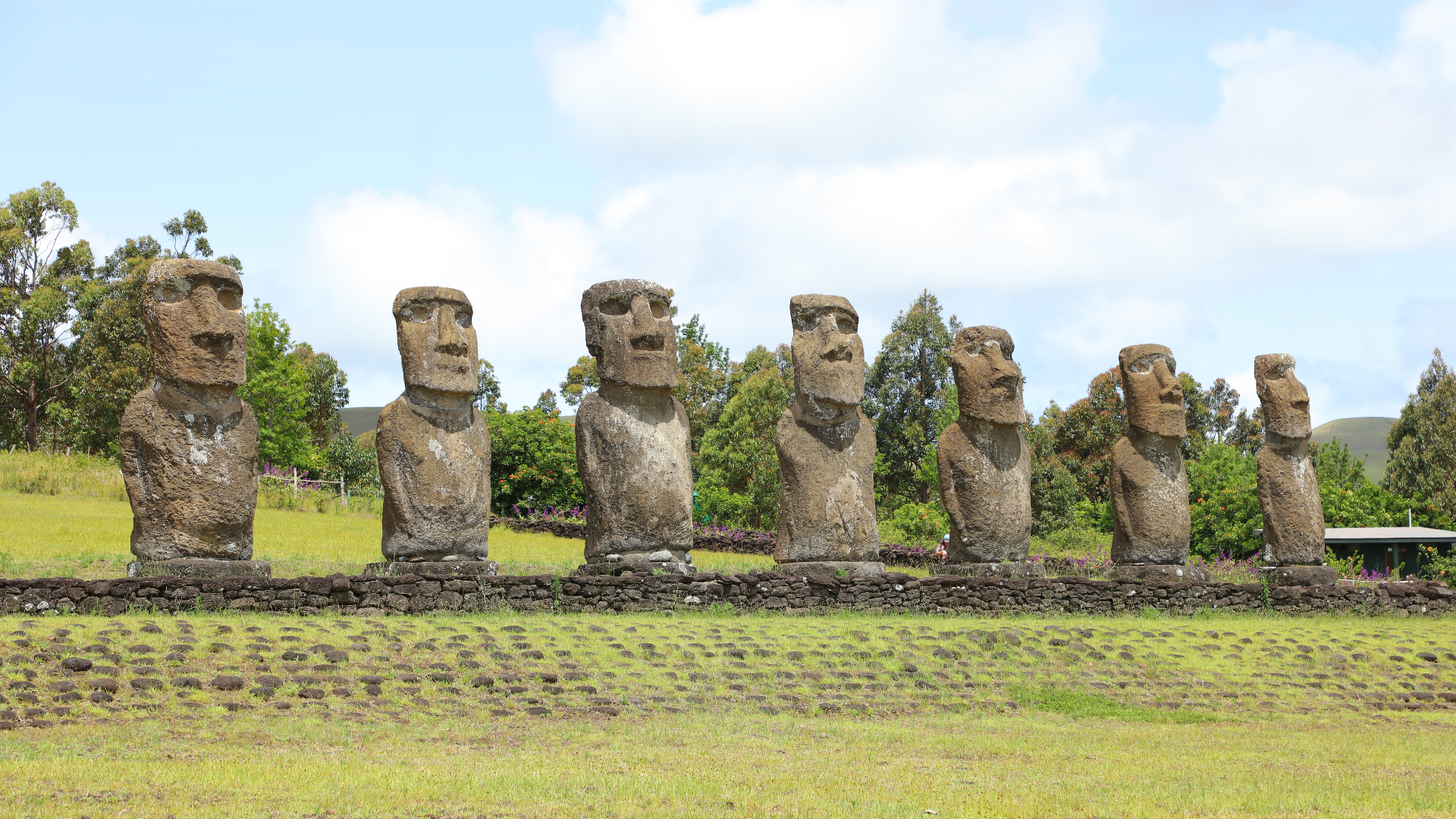
Easter Island Moai: The stone giants
The moai, the emblematic statues of Easter Island, are the most outstanding manifestation of Rapa Nui sculptural art and have become its worldwide symbol. Although numerous studies have been carried out on these stone giants, many questions still remain unanswered. Here we try to unravel some of the secrets surrounding the moai.
What are the Moai and what do they represent?
The moai, whose full name in the local language is Moai Aringa Ora, means “living face of the ancestors”. These statues were sculpted to represent the ancestors, rulers or important characters of the tribe, who, after their death, had the ability to extend their mana or spiritual power to protect their people. The most prosperous clans ordered the construction of a moai to honor the deceased with mana, erecting these statues in great celebrations.
How did they make the Moai?
The moai were carved mainly from lapilli tuff, a compact volcanic stone found in the Rano Raraku volcano. Master carvers used basalt and obsidian tools called toki. The process of carving a large moai could take up to two years. First the front part was worked and, in the final phase, the back was chiseled to detach the statue from the bedrock and transport it to the ahu or ceremonial altar.
How did they move the Moai?
Undoubtedly, the transportation of the moai remains one of the greatest mysteries. According to tradition, the moai “walked” to their destination. Several experiments have shown that it is possible to move a moai by swinging it from one side to the other, or by using a platform made of wood and ropes. Even so, the exact techniques used by the ancient Rapa Nui are still the subject of debate and study.
How many Moai are there on Easter Island?
Approximately 900 moai have been recorded on Easter Island. Of these, about 400 are found in the Rano Raraku quarry, 288 are associated with ahu, and the rest are scattered around the island. Most of the moai were carved in lapilli tuff, with some in white trachyte, red scoria and basalt.
How tall and heavy are these majestic statues?
The average height of the moai is about 4.5 meters, although some are up to 10 meters high. The largest moai, known as Te Tokanga, is unfinished at Rano Raraku and measures 21.65 meters, with an estimated weight of over 200 tons.
The standard weight of a moai is around 5 tons, although some weigh up to 40 tons. The largest moai, dating from the Ahu Moai Period (1500-1600 A.D.), weigh more than 10 tons.
Eyesighting and mana
Once the moai was installed in its ahu, its eye sockets were carved and white coral eyes with obsidian or red slag pupils were placed. This was done in a ritual ceremony, since it was believed that at that moment the moai recovered its mana and could protect its tribe. Today, no moai retains its original eyes.
The Pukao
Some moai wear a red headdress called pukao, made of red scoria from the Puna Pau volcano. This headdress, representing hair tied in a bun, adds a distinctive element to the statues. Fifty-eight moai with pukao have been recorded on the island.
Moai Form and Aesthetics
Moai have a rectangular shape with disproportionately large heads compared to their bodies. Their features include elongated noses, thin lips, long ears and prominent chins. The bodies have a low center of gravity with bulging abdomens and concave backs. In ancient times, it is likely that all moai were painted with red pigments, and some show relief designs representing tattoos.
If you are planning your trip to the island, explore our tours and discover the majesty of the moai and immerse yourself in the mysteries of these stone giants that continue to fascinate visitors and scholars from around the world.